
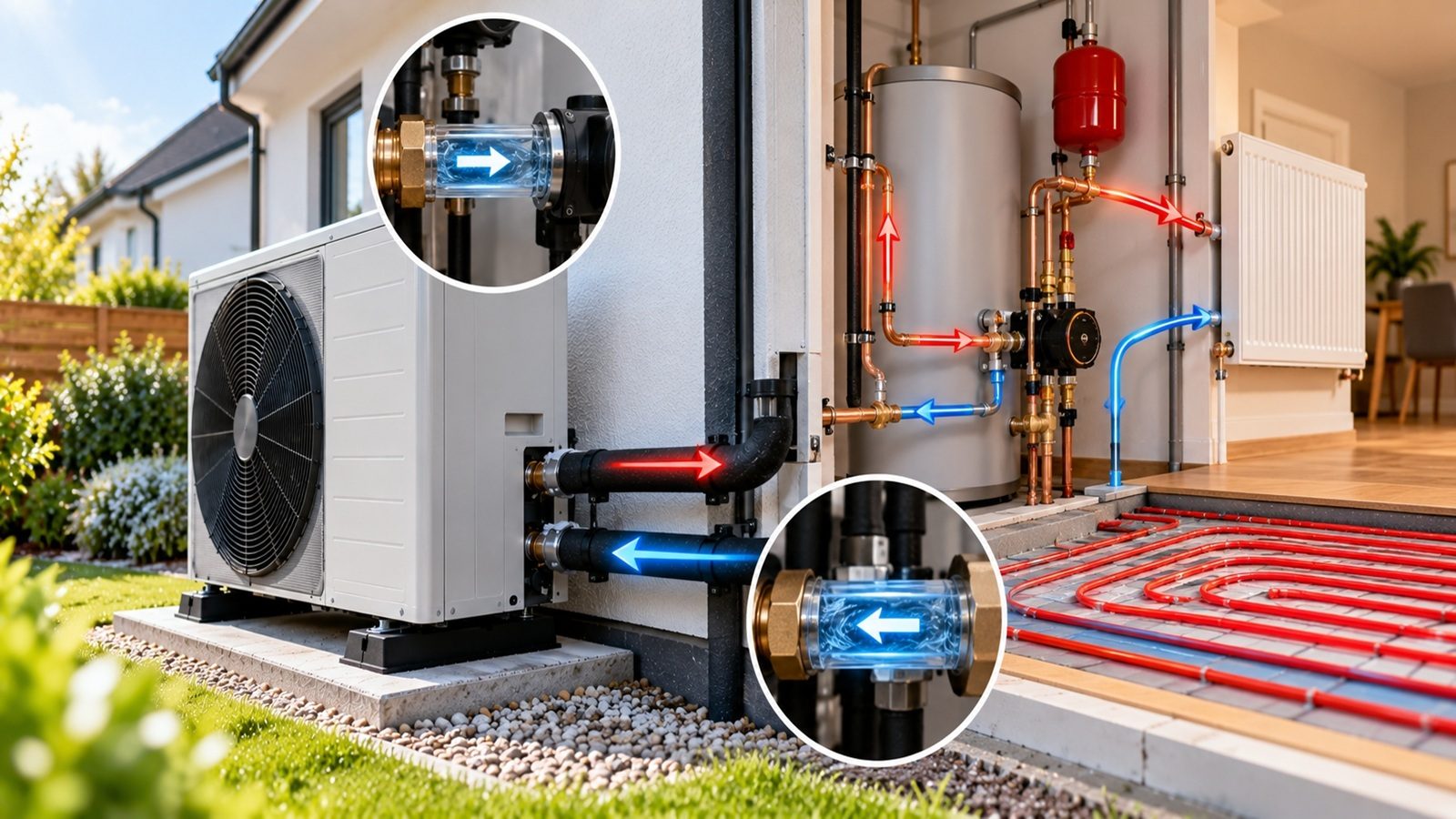
Water flow rate is an important factor in the performance of an air source heat pump. It affects how effectively heat is transferred from the heat pump to your radiators or underfloor heating, influencing comfort, efficiency, and overall system operation.
If the flow rate is too low, a heat pump may struggle to distribute heat correctly or trigger a flow-related warning. If it is too high, the system may experience unnecessary pumping energy use or hydraulic balancing issues. Understanding the basics helps homeowners recognise potential problems and know when to seek professional advice.
In this guide, Infinity explains how heat pump water flow rates work, what affects them, and how to recognise signs that your system may need attention.
What Is an Air Source Heat Pump Water Flow Rate?
Water flow rate describes the volume of water moving through a heating system over a given period. It is commonly measured in litres per minute (L/min) or cubic metres per hour (m³/h).
An air source heat pump transfers energy from outdoor air into water, which circulates through the home's heating system. The flow rate determines how much water carries that heat around the property.
Flow rate is different from flow temperature. Flow temperature is the temperature of the water leaving the heat pump, while flow rate measures how much water is moving through the system.
Both need to work together to deliver the required heat efficiently.
Why Is Water Flow Rate Important?
1. Effective heat transfer
A heat pump needs sufficient water circulation to transfer heat from its heat exchanger into the heating circuit. Inadequate flow can reduce heat transfer and may cause the unit to operate outside its intended conditions.
2. Consistent indoor comfort
Radiators and underfloor heating rely on suitable water circulation to distribute warmth. If flow is restricted, some rooms may heat slowly or remain cooler than expected.
However, uneven heating can also result from poor balancing, unsuitable radiator sizes, air in the system, or heat loss from the property.
3. Reliable heat pump operation
Many heat pumps monitor water flow and require a minimum rate specified by the manufacturer. If the flow falls below the required level, the system may display an error, stop temporarily, or activate a safety response.
The minimum flow requirement varies by model and operating conditions, so homeowners should consult the manufacturer's documentation rather than rely on a universal figure.
4. Efficient system performance
The correct flow rate helps the system transfer heat as intended. Efficiency also depends on factors such as flow temperature, outdoor conditions, system design, and the condition of the heating circuit.
Increasing flow is not automatically better. The goal is to achieve the manufacturer's requirements and the system designer's intended hydraulic performance.
What Determines the Correct Flow Rate?
There is no single water flow rate suitable for every air source heat pump installation. The correct value depends on several factors.
Heat pump output: Larger heat pumps may require greater water flow to transfer their heat output effectively.
Temperature difference: The difference between the water leaving and returning to the heat pump is known as the delta T (ΔT). The design delta T affects the flow rate required for a given heat output.
Heating system design: Pipe diameters, circuit lengths, valves, manifolds, and system resistance all influence water circulation.
Radiators or underfloor heating: Different heat emitters have different flow requirements. Underfloor heating often uses a manifold to distribute water across multiple circuits.
Manufacturer specifications: The heat pump's technical documentation sets important operating limits, including minimum flow requirements where applicable.
Installers consider these factors when designing and commissioning the system.
Understanding Flow Rate and Delta T
Flow rate and delta T are closely linked. In a typical heating circuit, water leaves the heat pump at a higher temperature and returns cooler after transferring heat to the property.
For a given heat output, a higher water flow generally produces a smaller temperature difference between flow and return, while a lower flow tends to produce a larger difference. Actual behaviour depends on the system's operating conditions.
For example, a heat pump might send water to the heating circuit at 35°C and receive it back at 30°C, giving a delta T of 5°C. These figures are illustrative, not universal targets.
The appropriate delta T depends on the heat pump model and system design. Homeowners should avoid changing pump speeds or flow settings simply to achieve a particular temperature difference without checking the manufacturer's guidance.
Signs Your Heat Pump May Have a Water Flow Problem
Some symptoms can indicate that circulation needs checking, although they may also have other causes.
Look out for:
- A flow-related warning or error code on the heat pump controller.
- Heating that is weaker than usual or takes longer to reach the desired temperature.
- Uneven warmth across radiators or underfloor heating zones.
- Unusual pump noise, bubbling, or gurgling in the heating circuit.
- The system stopping unexpectedly or repeatedly failing to operate normally.
If you notice these symptoms, check the user manual for safe homeowner checks. Do not remove covers, dismantle components, or alter advanced settings. Contact a qualified heating engineer if the issue persists or the system displays a fault.
What Can Cause Low Water Flow?
Several issues may restrict water circulation through an air source heat pump.
Air in the heating system
Trapped air can interfere with circulation and cause noise or uneven heating. If you suspect air in the system, follow the installer's advice rather than bleeding components without understanding the system requirements.
Blocked filters or strainers
Debris can accumulate in filters or strainers and restrict flow. These components may need inspection and cleaning by a suitably qualified professional, following the manufacturer's instructions.
Incorrect valve settings
Closed or partially closed valves can reduce circulation. Do not adjust unfamiliar valves, as some settings are essential to safe and balanced operation.
Pump or control issues
A circulation pump fault, incorrect configuration, or control problem may affect flow. These issues require appropriate diagnosis.
Poor system balancing
If the heating circuits are not balanced correctly, water may not be distributed as intended. A professional can assess the system and make suitable adjustments.
How Can Homeowners Help Maintain Correct Water Flow?
Although technical adjustments should be left to qualified professionals, homeowners can take several sensible steps.
- Keep the heat pump's outdoor unit clear of leaves and other obstructions, following the manufacturer's guidance.
- Monitor the controller for persistent warnings or unusual operating behaviour.
- Arrange servicing in line with the manufacturer's recommendations.
- Report recurring cold spots, unusual noises, or unexplained changes in heating performance.
- Keep records of error codes and when problems occur to help an engineer diagnose the issue.
Avoid changing circulation pump settings, bypass valves, or installer-level parameters unless specifically advised by a qualified professional.
Does Water Flow Rate Affect Running Costs?
Yes, water circulation can influence overall system performance, but the relationship is not as simple as increasing the flow rate to reduce bills.
If flow is insufficient, the heat pump may transfer heat poorly or operate outside its intended range. On the other hand, unnecessarily high circulation can increase pump electricity use and may affect the hydraulic balance of the system.
Good system design, appropriate flow temperature, correctly sized heat emitters, and regular maintenance all contribute to efficient operation. Actual running costs also depend on insulation, household heating patterns, the weather, and electricity tariffs.
Conclusion
Understanding air source heat pump water flow rates can help homeowners recognise why circulation matters for comfort, reliability, and efficiency. The correct flow rate depends on the heat pump, heating circuit, design temperature difference, and manufacturer's requirements.
If your heating system shows flow-related errors, heats unevenly, or makes unusual noises, avoid guessing at the settings. A qualified heating professional can check circulation, inspect relevant components, and confirm that the system is operating as designed.
Need advice about your air source heat pump? Contact Infinity to discuss your heating requirements and get guidance on maintaining a reliable, efficient heating system for your home.
Ready to improve your home's energy efficiency?
Check your eligibility for grants and book a free survey with our team.
Book Free Survey