
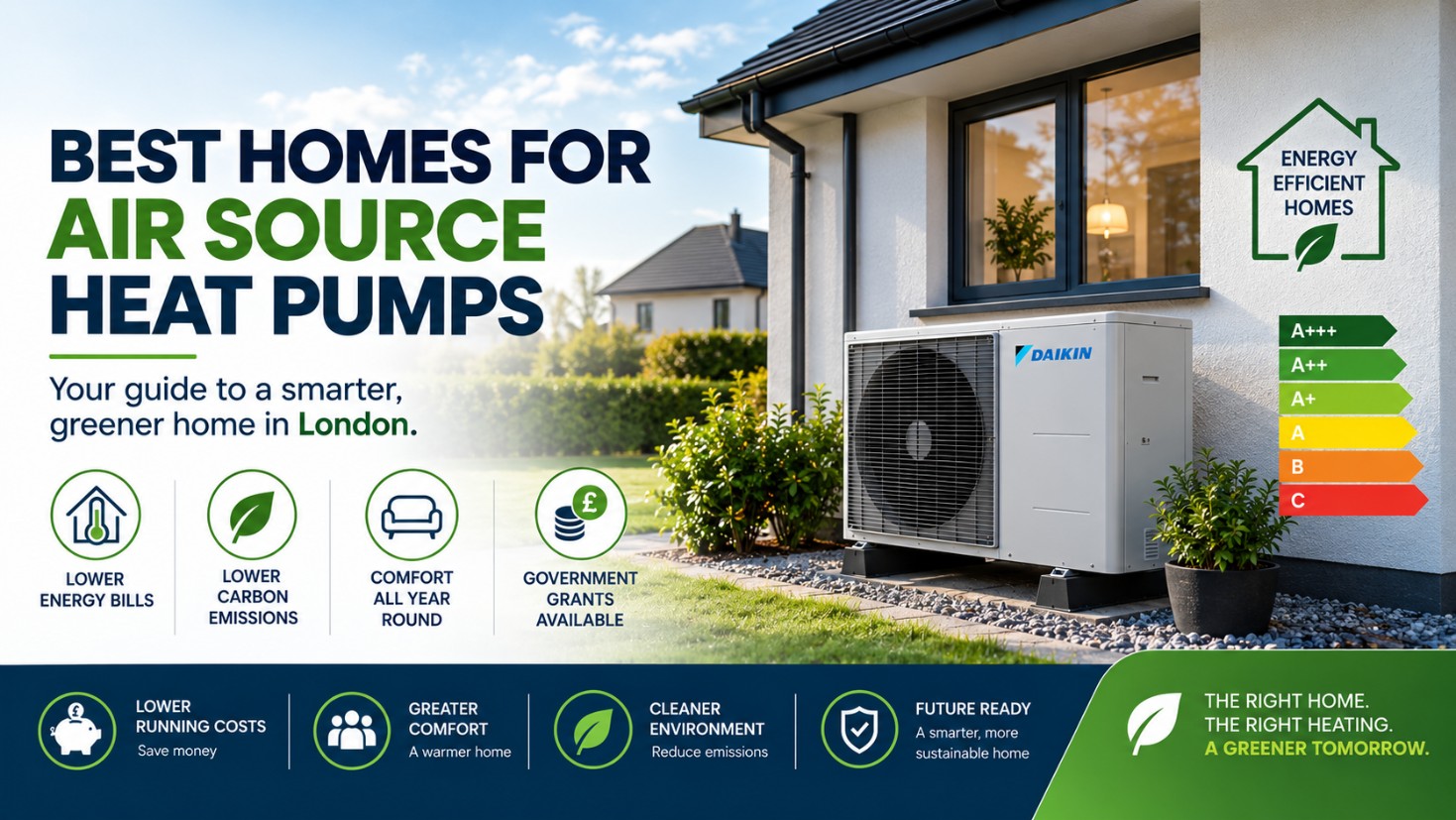
Air source heat pumps are becoming an increasingly popular heating option for London households looking to improve energy efficiency and move towards lower-carbon heating.
The good news is that there is no single type of house that can use a heat pump. Modern systems can be designed for detached houses, semi-detached homes, terraces, flats and older buildings. Energy Saving Trust fieldwork has demonstrated successful installations across different property types and ages, including pre-1945 homes.
Some properties provide better conditions for installation. Insulation, heat loss, available outdoor space, radiators, hot water requirements and the overall heating system all need consideration.
What Makes a Home Suitable?
An air source heat pump takes heat from outside air and transfers it into your home for space heating and, with an air-to-water system, hot water. Unlike a conventional boiler, it generally works with lower water temperatures, so the building and heating system need to work together effectively.
Important factors include good insulation, reasonable airtightness, suitable heat emitters, adequate outdoor space, internal space for equipment, correct electrical capacity and a heating system designed around the property's heat demand.
MCS guidance uses room-by-room heat-loss calculations that consider the building fabric, room dimensions, ventilation, desired temperatures, and external design conditions. A heat-loss assessment is therefore more useful than judging suitability simply by a property's age or size.
Well-Insulated Homes
Homes that retain heat effectively are generally well suited to heat pump technology. Good insulation reduces heat escaping through external walls, roofs, lofts, floors, windows and doors. This lowers the amount of heat the system needs to supply.
This does not mean every part of a home must be perfect before considering a heat pump. An installer should assess heat-loss characteristics and identify worthwhile improvements.
Detached, Semi-Detached, and Terraced Homes
Detached houses can work very well with air source heat pumps when their insulation and heating systems are suitable. Detached properties have more external wall and roof area, which can mean greater heat loss, particularly in older or poorly insulated buildings.
Semi-detached homes can also be excellent candidates. Because one side shares a wall with a neighbouring property, their heat-loss profile can differ from a detached home. Existing radiators may be retained if appropriately sized for lower heat-pump flow temperatures, although larger radiators may sometimes be recommended.
Terraced properties are not automatically unsuitable. Shared walls can reduce the external surface exposed to outdoor conditions. However, practical issues can include limited access, smaller gardens, restricted outdoor-unit locations, compact utility areas, older heating systems, and conservation-area considerations. A site survey can determine whether there is a practical outdoor-unit position.
Older London Homes
Older homes can also use air source heat pumps. Energy Saving Trust reports successful installations in properties of different ages, including homes built before 1945. Older properties may simply require more preparation.
Potential improvements include loft insulation, cavity wall insulation where appropriate, draught reduction, improved glazing, larger radiators, heating controls, and building-fabric repairs. The important point is to assess actual heat loss rather than rejecting a property because of its age.
Underfloor Heating and Radiators
Underfloor heating can be a strong match because its large surface area can distribute heat effectively at lower water temperatures. However, underfloor heating is not essential. Existing radiators may also be suitable depending on their size, the property's heat loss and the required flow temperature.
A radiator that works well with a traditional boiler may not provide enough heat at a lower heat-pump temperature. An installer can calculate individual room requirements and determine whether existing radiators are adequate, some need replacing, or larger radiators would help.
What About Poor Insulation?
Poor insulation does not automatically mean a heat pump cannot be installed. However, improving insulation can reduce heat loss and help the system operate more efficiently.
Energy Saving Trust recommends completing planned insulation improvements before installation where possible, allowing the heat pump to be designed around improved heat-loss requirements. Insulation and heating should therefore be considered as part of the same energy-efficiency plan.
Installation Costs and Grants
Installation costs vary considerably. Energy Saving Trust puts the typical cost of an air source heat pump at around £11,000, although actual prices depend on property size, system size and whether radiators require upgrading.
For eligible properties in England and Wales, the Boiler Upgrade Scheme provides £7,500 towards an air-to-water heat pump. Eligible off-gas-grid properties replacing oil or LPG systems may qualify for a higher £9,000 grant. Government schemes and eligibility can change, so homeowners should check current requirements.
How Infinity Helps Homeowners
At Infinity, we understand that every home has different heating requirements. Our approach considers property size, insulation, existing heating systems, radiator requirements, electrical capacity, outdoor-unit positioning and hot water arrangements.
A professional assessment can help determine whether a property is suitable and identify an appropriate heating solution.
Conclusion
The best home for an air source heat pump is not defined simply by whether it is new, old, detached, terraced, a flat or large. Heat pumps can work across many London properties when properly designed around the building's heat demand.
Well-insulated homes with suitable heat emitters, adequate outdoor space and room for internal equipment can provide particularly good conditions. Older homes, flats and properties with existing radiators can also be suitable, although they may require more detailed planning or improvements.
The most important step is to assess the property as a whole. If you're considering an air source heat pump, Infinity can help assess your home's requirements and identify a suitable solution.
Ready to improve your home's energy efficiency?
Check your eligibility for grants and book a free survey with our team.
Book Free Survey