
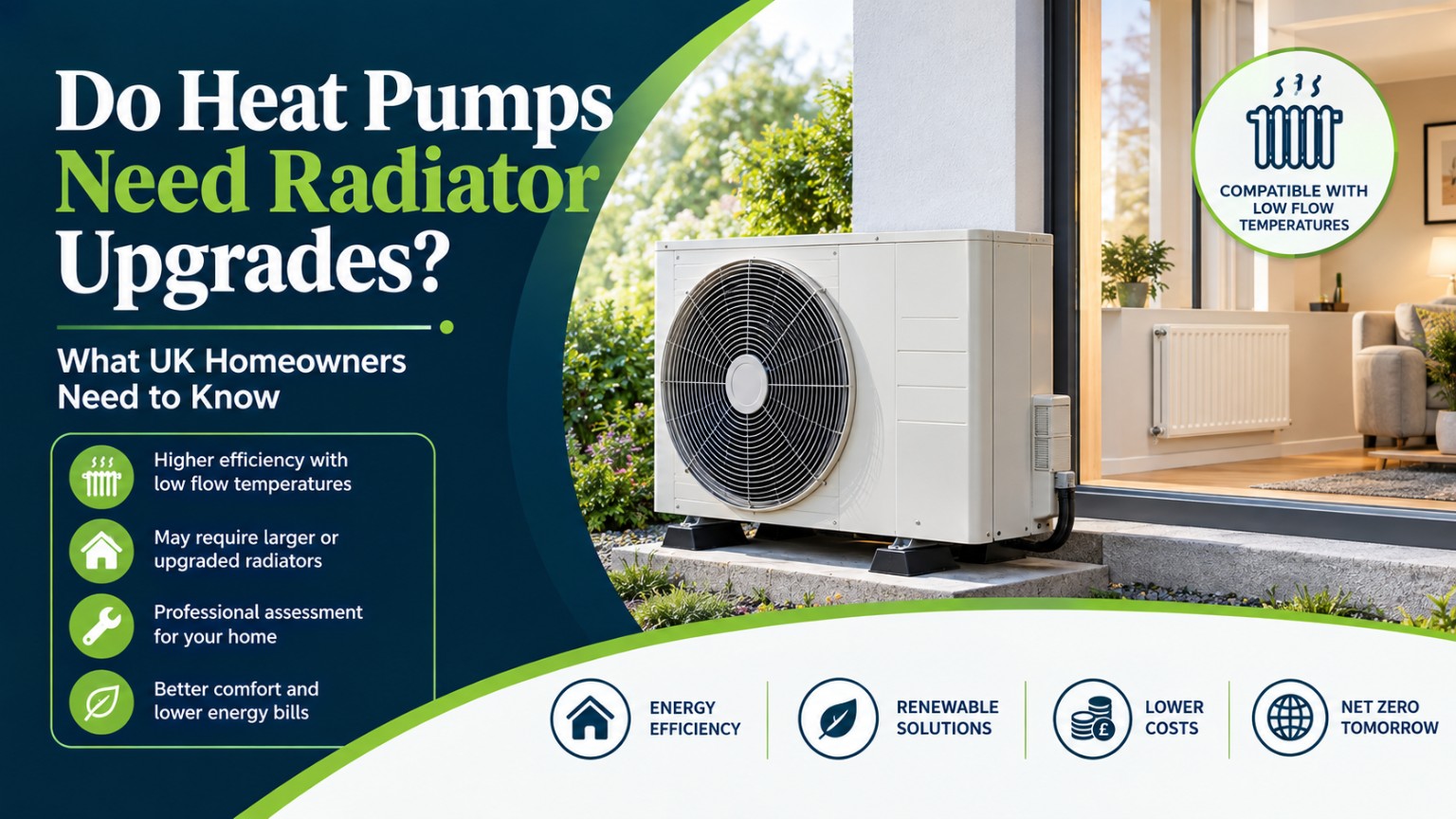
Thinking about replacing your boiler with an air source heat pump? You may wonder whether your existing radiators will still work.
In some homes, existing radiators can remain. In others, selected upgrades may be necessary. The answer depends on the property's heat demand, insulation, building condition, and system design.
Why Can Radiator Size Matter?
Water temperature affects how much heat a radiator releases. A traditional boiler can provide relatively high-temperature water, while a heat pump normally operates at lower flow temperatures for efficient heating.
As a result, an existing radiator may produce less heat with a heat pump than it did with a boiler. If its output is insufficient, a larger radiator, different radiator type, or additional heat emitter may be required.
However, this does not mean every radiator needs upgrading.
Can You Keep Existing Radiators?
Often, yes.
The key question is whether each radiator can provide enough heat for its room under the proposed operating conditions.
A correctly sized radiator in a small, well-insulated bedroom may already have enough capacity. A smaller radiator in a large lounge with several external surfaces may not.
Radiator age alone does not determine suitability. Size, type, condition, and expected heat output all matter. A professional assessment is therefore more useful than assuming all radiators must be replaced.
Why Might Some Radiators Need Replacing?
An existing radiator may be too small for the room, or the room may lose significant heat through walls and windows. Because a heat pump may operate at a lower flow temperature, a radiator that worked adequately before may not provide enough heat afterwards.
Modern high-output radiators are available in various sizes and styles, so an upgrade does not necessarily compromise your room's appearance.
The Role of Home Insulation
Before focusing on radiators, consider how much heat your home is losing.
Poor insulation can increase heating demand, with heat escaping through the roof, walls, floors, and windows. Reducing heat loss can lower the heat your new system needs to provide.
Insulation and renewable heating can therefore complement each other. Infinity offers energy-efficiency solutions alongside renewable technologies, helping homeowners improve their property's overall performance.
Is Underfloor Heating Required?
No.
Underfloor heating works well with heat pumps because its large surface area distributes heat effectively at relatively low temperatures. However, it is not essential.
Radiators can work with an air source heat pump when they provide sufficient output, making upgrades less disruptive.
What If You Have an Older House?
Older properties can present different challenges because construction, insulation, and heating systems vary. An older home can still be suitable for a heat pump, but it should be assessed carefully. The installer needs to understand the building's heat requirement and how heat will be distributed.
In some cases, insulation improvements may be worthwhile. In others, only selected radiators may need attention. The objective is to design the system around the actual property.
What Should Be Checked Before Installation?
Important factors include room size and layout, building heat loss, insulation, windows and doors, radiator size and type, existing pipework, heating controls, intended flow temperature, and required heat pump capacity.
Assessing these elements together shows whether radiator upgrades are necessary and helps avoid paying for work your property does not need.
Could Only One or Two Radiators Need Upgrading?
Absolutely. Different rooms have different heating requirements. A large open-plan area may need more heat than a bedroom, while a room with several external walls may lose more heat.
An assessment may therefore find that most existing radiators can remain while only one or two need upgrading. This targeted approach can make modernising an existing property more practical and less disruptive.
Do Heat Pumps Need Radiator Upgrades?
Not always.
A heat pump can work with existing radiators when they provide enough heat at the system's intended operating temperature. Where they do not, upgrading selected radiators can improve heating performance.
There is no reason to replace every radiator simply because you are moving to renewable heating. The sensible approach is to assess the property first and make improvements where they are genuinely required.
Explore Heat Pump Options With Infinity
Moving to a heat pump is a significant decision, so understanding how the system will work with your existing home is important.
Infinity provides renewable energy and energy-efficiency solutions for homeowners looking to improve how their properties use energy.
If you are considering an air source heat pump, our team can help you explore available options and understand what may be involved in upgrading your home.
Get a Free Quote Today
Ready to review your heating options? Get a Free Quote Today and speak to Infinity about your home and energy goals.
Frequently Asked Questions
Will an air source heat pump work with existing radiators?
It can. Existing radiators may be retained where their heat output suits the room and proposed system.
How can I tell if the radiators are too small?
Compare their expected heat output with the room's heating requirement. A professional assessment is the most reliable approach.
Does a heat pump require underfloor heating?
No. Appropriately sized radiators can be used with an air source heat pump.
Should I upgrade insulation?
Improving insulation can reduce heat loss and heating requirements, depending on the property's condition.
Ready to improve your home's energy efficiency?
Check your eligibility for grants and book a free survey with our team.
Book Free Survey