
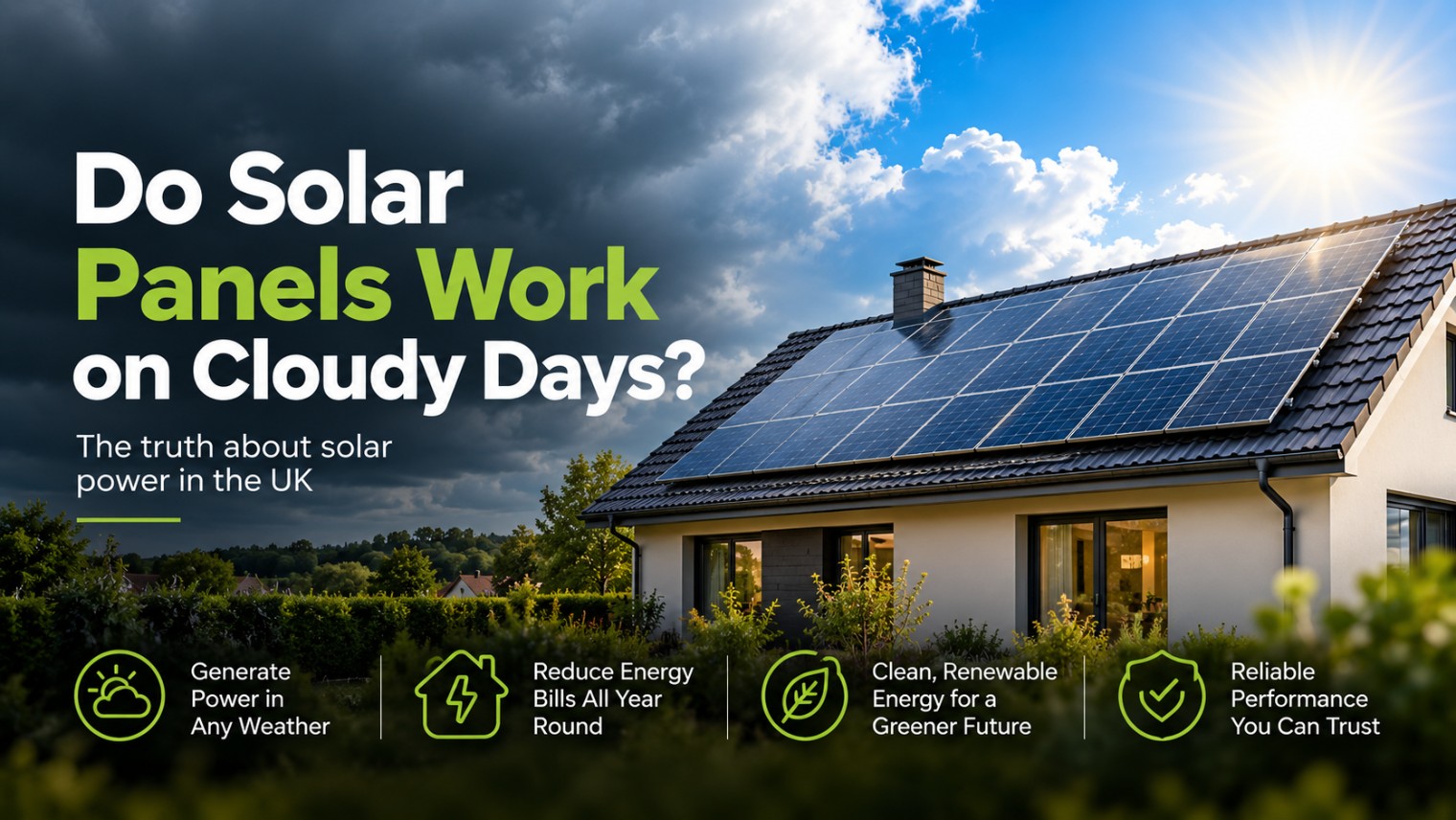
When people think about solar panels, they often imagine bright sunshine and clear blue skies. This can lead to the question: do solar panels work on cloudy days?
The answer is yes. Solar panels can still generate electricity on cloudy days, although they usually produce less power than they would in strong, direct sunshine.
For London homeowners, it is important to consider solar panel performance across the entire year rather than judging a system based on one cloudy day.
How Do Solar Panels Work When It Is Cloudy?
Solar photovoltaic (PV) panels generate electricity when light reaches their photovoltaic cells. They do not require constant direct sunshine to operate.
On clear days, sunlight reaches the panels directly. When clouds are present, some light is scattered before reaching them. This usually reduces electricity generation, but the panels can continue producing power from the available daylight.
The amount of electricity generated depends on several factors, including:
- Cloud thickness and weather conditions.
- The amount of daylight available.
- The season and time of day.
- Your roof's orientation and pitch.
- The size and efficiency of your solar PV system.
- Shading from trees or nearby buildings.
- The condition of the panels and wider system.
Because every property is different, there is no single amount of electricity that solar panels will produce on a cloudy day.
Will Solar Panels Generate Less Electricity on Cloudy Days?
Usually, yes. Direct sunlight provides more energy than diffused daylight, meaning solar panels generally produce their highest output during bright sunshine.
However, lesser sunlight does not mean zero generation. A bright, lightly overcast day can still provide useful daylight, while heavy clouds can reduce output more significantly.
Solar generation naturally changes throughout the day and across different seasons. For this reason, performance should be considered over weeks, months and years rather than based on one cloudy afternoon.
Do Solar Panels Work in London?
Yes. London's changing weather does not prevent solar PV systems from generating electricity.
Although London receives less intense sunshine than some countries, solar panels can use the daylight available. Spring and summer generally provide longer daylight hours, while electricity generation usually falls during the shorter days of winter.
The performance of an installation also depends on the property. A well-positioned roof with limited shading may generate more electricity than a roof affected by trees or surrounding buildings.
A professional assessment can help determine whether your property is suitable for solar PV.
What Happens During Winter?
Solar panels can still generate electricity during winter, but production is generally lower because daylight hours are shorter and the sun is lower in the sky.
Cold weather itself does not stop solar panels from working. Solar PV technology uses light, rather than heat, to generate electricity.
The main factors affecting winter performance are limited daylight, cloud cover and shading.
Can Solar Panels Work When It Is Raining?
Yes. Rain does not automatically stop solar panels from generating electricity.
The amount of daylight reaching the panels is more important. A rainy day with heavy clouds may produce less electricity, while a brighter day with passing showers may produce more.
Rain can also help rinse loose dust and debris from the surface of panels.
What If Your Solar Panels Do Not Generate Enough Electricity?
Your home does not have to depend entirely on solar power.
If your household requires more electricity than your solar panels are generating, the additional electricity can normally be supplied through the grid.
For example, on a cloudy afternoon, your panels may generate some electricity but not enough to power every appliance in your home. The grid can normally supply the difference.
Could a Solar Battery Help?
A solar battery can store surplus electricity generated during the day for potential use later.
This can be useful for households that consume more electricity during the evening when solar generation has reduced or stopped.
However, battery storage is not necessary for every home. Its suitability depends on your electricity use, solar generation, available space, and system design.
How Can You Get More from Your Solar Panels?
You can make better use of your solar generation by considering when your household uses electricity.
Where practical, running appliances during daylight hours may help you use more of the electricity generated by your panels.
It is also useful to monitor shading. Trees can grow over time, while nearby structures may affect the amount of light reaching your roof.
Regularly checking your system's performance can also help identify unexpected changes.
Are Solar Panels Worth Having Despite Cloudy Weather?
For many London properties, cloudy weather alone is not a reason to dismiss solar energy.
The important factors include:
- Roof orientation and pitch.
- Shading.
- System size.
- Household electricity consumption.
- Expected long-term performance.
Solar should be assessed based on its performance throughout the year rather than whether it produces maximum electricity every day.
Frequently Asked Questions
Do solar panels work on completely cloudy days?
Yes. They can generate electricity from diffused daylight, although heavy clouds can significantly reduce output.
Do solar panels need direct sunlight?
No. Solar panels can generate electricity from both direct and indirect light.
Do solar panels work during winter?
Yes. They continue generating electricity when sufficient daylight is available, although winter output is generally lower.
Is a solar battery necessary?
No. A battery is optional and may be suitable depending on your household and energy requirements.
Make the Most of Solar Energy in London
Cloudy skies do not mean solar panels stop working. They can continue converting available daylight into electricity, although output is generally lower than during bright sunshine.
For London homeowners, solar performance should be considered across the year. A properly designed system can make use of available daylight throughout changing weather conditions.
If you are considering solar PV, Infinity can help you explore whether solar energy is suitable for your property and find the right solution for your home.
Ready to improve your home's energy efficiency?
Check your eligibility for grants and book a free survey with our team.
Book Free Survey