
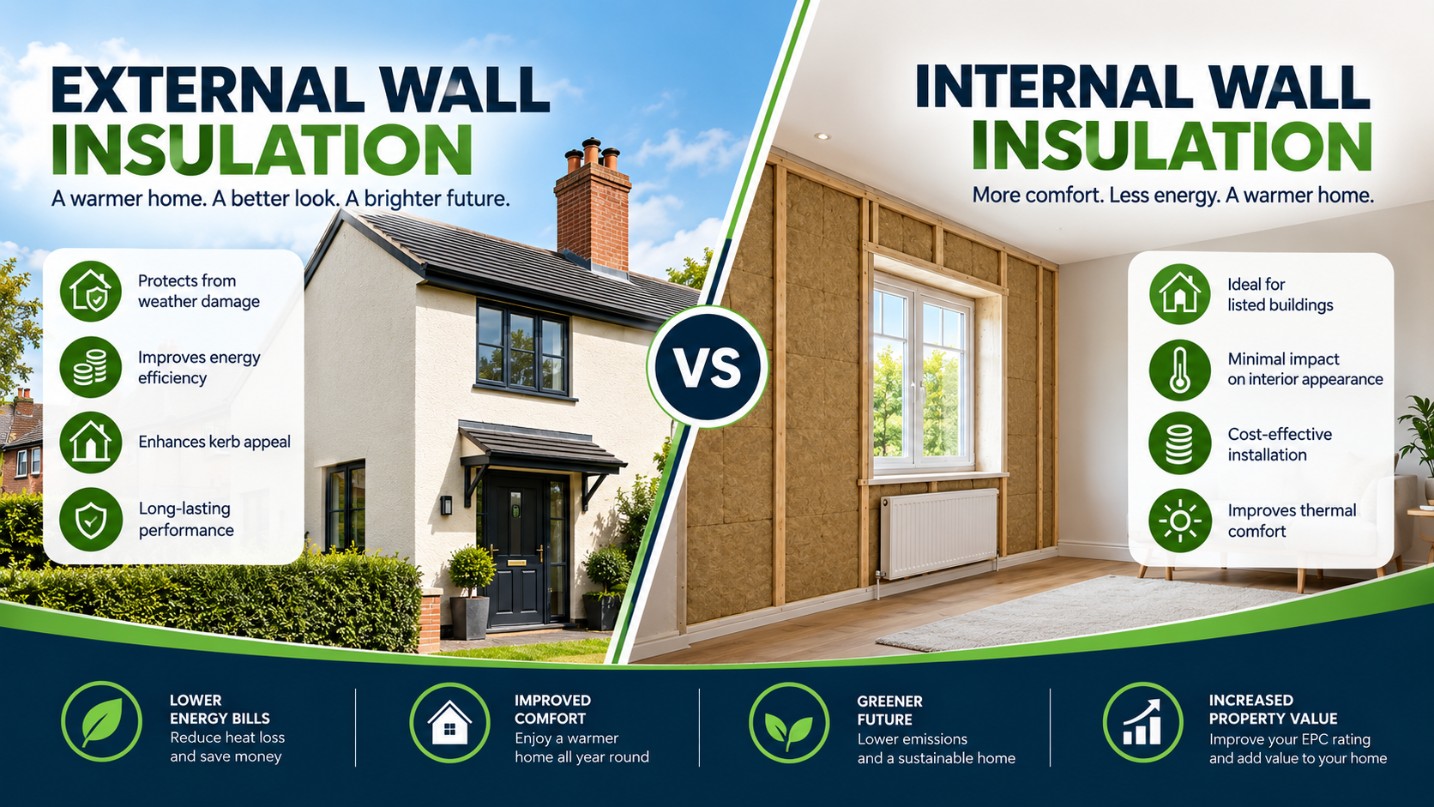
Improving your home's insulation is an effective way to reduce energy bills, increase comfort, and improve energy efficiency. London homeowners often need to choose between external wall insulation and internal wall insulation. Both reduce heat loss, but they differ in installation, cost, appearance, and suitability.
If you own an older home with solid walls, understanding these differences can help you choose the right solution.
Why Wall Insulation Matters
Older London homes often have solid brick or stone walls and may lose significant heat through their walls. Installing wall insulation can help:
- Reduce heat loss
- Lower heating bills
- Improve indoor comfort
- Reduce condensation
- Improve EPC ratings
- Lower carbon emissions
Both external and internal insulation can improve thermal performance when correctly designed and installed.
What Is External Wall Insulation?
External wall insulation involves fixing insulation boards to the outside walls before covering them with protective render or decorative cladding.
It creates a continuous thermal layer around the building, helping reduce heat loss while providing additional protection against weather conditions. It is particularly suitable for many solid-wall properties.
What Is Internal Wall Insulation?
Internal wall insulation is installed on the inside surfaces of external walls. Insulated boards or other systems are fitted before the walls are plastered and decorated.
Unlike external insulation, it does not change the property's exterior appearance. This can make it suitable for listed buildings, conservation areas, or properties where external alterations are restricted.
How Do They Compare?
Heat Retention
External insulation creates a continuous insulating layer around the building, helping reduce thermal bridging and maintain more stable indoor temperatures.
Internal insulation also reduces heat loss but may leave thermal bridges around floors, ceilings, and internal walls. For maximum thermal performance, external insulation can have an advantage.
Installation Process
External Wall Insulation
Installation generally includes:
- Property survey
- Surface preparation
- Insulation board installation
- Reinforcement mesh
- Protective render or cladding
- Final inspection
Most work takes place outside, meaning there is minimal disruption inside the property.
Internal Wall Insulation
Internal installation may involve:
- Preparing internal walls
- Moving or removing fixtures
- Installing insulation boards
- Plastering
- Decorating
- Reinstalling fixtures
This can create greater disruption for occupied homes.
Living Space
External insulation does not reduce internal room sizes because the work is carried out externally.
Internal insulation slightly reduces room dimensions. This may be important in smaller properties where available space is limited.
Appearance
External insulation can transform the property's exterior through a new render or decorative finish. It can improve kerb appeal while upgrading thermal performance.
Internal insulation leaves the exterior unchanged, making it useful for:
- Listed buildings
- Conservation areas
- Homes with decorative brickwork
- Properties with planning restrictions
Protection Against Weather
External insulation provides an additional protective layer around the building. Depending on the system and finish, it can help protect walls from rain, frost, temperature changes, and moisture penetration.
Internal insulation improves thermal performance but does not provide the same external weather protection.
Condensation and Damp
Both systems can help reduce condensation when professionally designed and installed.
External insulation keeps the wall structure warmer, which can reduce the likelihood of condensation on internal surfaces.
Internal insulation requires careful moisture management because condensation can potentially develop between the insulation and original wall. Professional assessment is important for both systems.
Cost Comparison
Costs vary depending on property size, wall construction, access, insulation materials, and finishes.
External Wall Insulation
- Higher upfront cost
- Larger installation project
- Potentially greater long-term energy savings
- Exterior renovation included
Internal Wall Insulation
- Lower initial cost in some properties
- Smaller installation area
- Additional plastering and decoration
- Potentially more affordable for specific applications
Homeowners should consider both installation costs and long-term energy savings.
Which Properties Suit External Wall Insulation?
External insulation can be suitable for:
- Solid-wall homes
- Detached houses
- Semi-detached properties
- Terraced homes
- Properties needing exterior renovation
- Homes with poor thermal performance
Victorian, Edwardian, and other older properties may benefit significantly from improved wall insulation.
Which Properties Suit Internal Wall Insulation?
Internal insulation may be preferable when:
- The exterior appearance must remain unchanged
- The property is listed
- Planning restrictions limit external alterations
- Boundary restrictions prevent external work
- Only specific walls require insulation
A professional assessment can help determine the most suitable approach.
Energy Efficiency Benefits
Both systems can reduce heat loss and improve overall energy performance.
Benefits may include:
- Lower heating bills
- Improved comfort
- Reduced energy consumption
- Better EPC ratings
- Lower carbon emissions
- Reduced reliance on central heating
Combining wall insulation with loft insulation, efficient heating, and quality glazing can further improve energy efficiency.
Can Government Grants Help?
Some London homeowners may qualify for funding through government-backed energy-efficiency schemes. Eligibility can depend on:
- Household income
- Property type
- EPC rating
- Location
- Local authority schemes
A professional installer can advise whether funding options may be available.
Choosing the Right Solution
The best insulation method depends on:
- Property age
- Construction type
- Budget
- Planning restrictions
- Exterior appearance
- Available internal space
- Long-term energy goals
There is no single solution suitable for every property. A professional survey can help identify the most appropriate system.
Why Professional Installation Matters
Wall insulation is a long-term investment and must be installed correctly. Professional installers can ensure:
- Proper moisture management
- Correct fixing methods
- Compliance with relevant requirements
- Effective thermal performance
- Long-term durability
Poor installation can reduce efficiency and contribute to condensation or other building problems.
Why Choose Infinity?
Infinity provides professional external wall insulation and internal wall insulation solutions for homeowners across London.
Our experienced team assesses each property before recommending the most suitable system. Whether your home is better suited to external or internal insulation, we provide tailored solutions designed to improve comfort, reduce heat loss, and support long-term energy efficiency.
Conclusion
Choosing between external wall insulation and internal wall insulation depends on your property's construction, planning requirements, available space, and long-term goals.
External insulation can provide excellent thermal performance and weather protection, while internal insulation may be better where preserving the property's exterior is important.
Both systems can deliver significant energy-efficiency benefits when professionally designed and installed. Choosing the right solution can help you enjoy lower energy bills, improved comfort, and a more efficient home for years to come.
Ready to improve your home's energy efficiency?
Check your eligibility for grants and book a free survey with our team.
Book Free Survey