
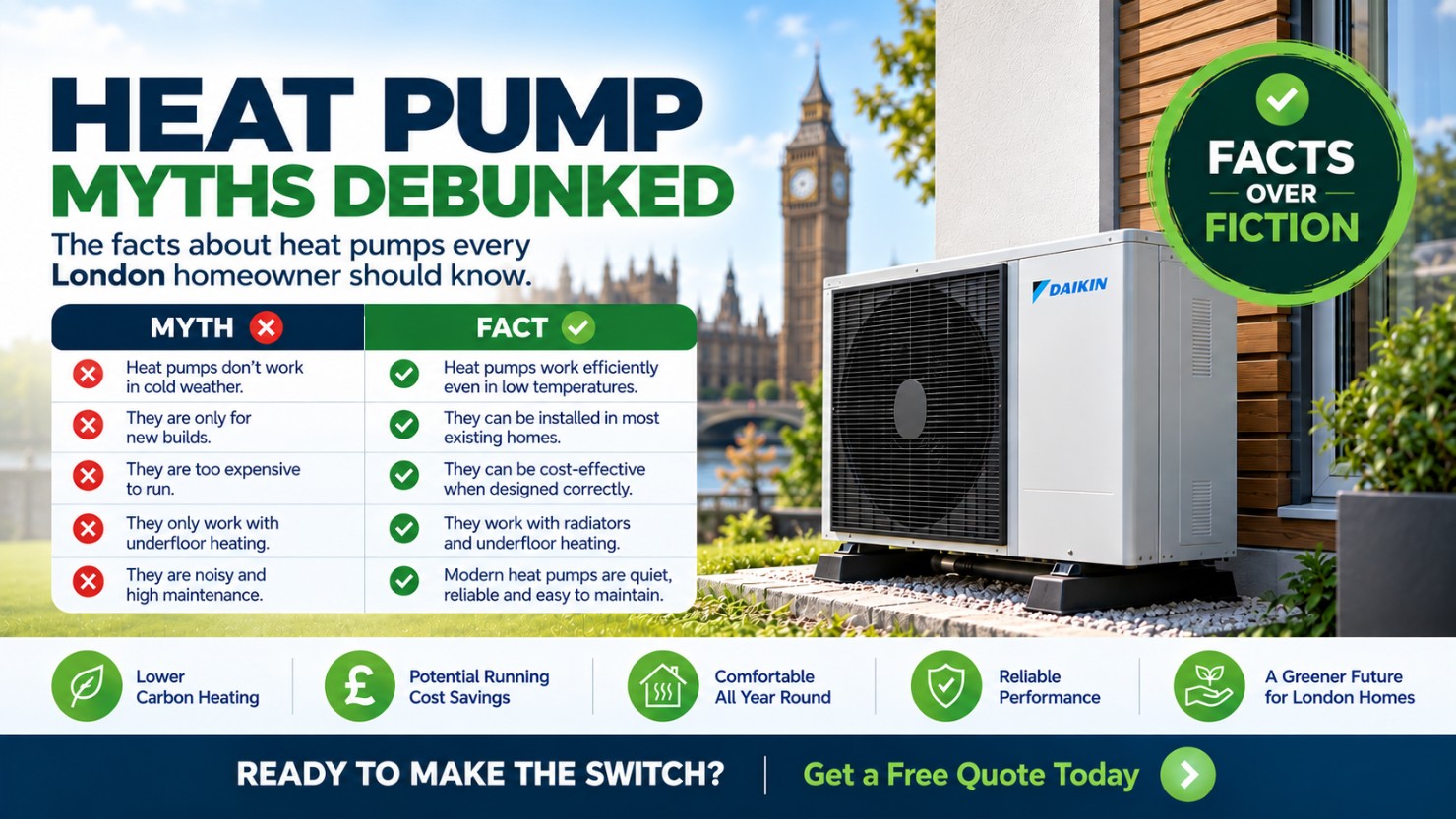
Heat pumps are becoming a popular heating option for London homes, but myths remain about their performance, running costs, and suitability for British properties. Understanding the facts can help you decide whether a heat pump is right for your home.
What Is an Air Source Heat Pump?
An air source heat pump takes heat energy from outside air and transfers it into your home. It can extract heat during cold weather, although performance varies with temperature and system design.
Unlike a boiler, it does not burn fuel to generate heat. Instead, it uses electricity to move heat indoors. Heat can be distributed through radiators or underfloor heating, and the system can also provide domestic hot water.
Myth 1: Heat Pumps Do Not Work in Cold Weather
False. Air source heat pumps are designed to operate in cold conditions. They may work harder as temperatures fall, but they do not simply stop working. Correct sizing is essential.
Myth 2: Heat Pumps Cannot Be Used in Older Homes
False. Older properties can potentially use heat pumps. Their insulation, heat loss, windows, radiators, hot water requirements, outdoor space, and electrical capacity should be assessed first.
Improving insulation and reducing draughts can also help the system operate effectively. The property's condition matters more than its age.
Myth 3: Heat Pumps Are Not Powerful Enough
Heat pumps operate differently from boilers. They generally supply heat at lower temperatures over longer periods rather than producing very high temperatures quickly.
A correctly sized system can maintain comfortable indoor temperatures consistently.
Myth 4: Heat Pumps Only Work with Underfloor Heating
False. Underfloor heating can work well with heat pumps, but it is not essential. Suitable radiators can also be used. Some existing radiators may be adequate, while others may need upgrading.
Myth 5: Heat Pumps Are Always Expensive to Run
There is no universal answer. Running costs depend on your electricity tariff, property heat demand, system efficiency, controls, and operating conditions.
Good insulation, suitable heat emitters, and appropriate settings can support efficient operation. Consider your property's expected performance rather than relying on general claims.
Myth 6: Heat Pumps Are Extremely Noisy
Modern air source heat pumps are designed with noise control in mind, although outdoor units produce some sound from their fan and compressor.
Noise depends on the equipment, location, and operating conditions. Correct positioning can help minimise disturbance.
Myth 7: Every Radiator Must Be Replaced
False. Radiator replacement depends on size, output, and operating temperature. A heat loss and emitter assessment can identify which radiators are suitable and whether any need upgrading.
Myth 8: Heat Pumps Are Difficult to Use
A well-designed heat pump should not require constant adjustment. These systems are generally designed to operate steadily.
Modern controls can manage heating schedules, room temperatures, and hot water. Your installer should explain how your system works.
Myth 9: Heat Pumps Stop Working When It Freezes
Freezing temperatures do not automatically stop an air source heat pump. Frost can form on the outdoor heat exchanger, but systems have automatic defrost functions.
Persistent ice or performance problems should be checked by a qualified professional.
Myth 10: Heat Pumps Are Maintenance-Free
False. Heat pumps require maintenance. Keep the outdoor unit clear of leaves and debris and monitor it for unusual noises, warnings, or changes in performance.
Follow the manufacturer's servicing recommendations.
Myth 11: Heat Pumps Are Only Suitable for New Builds
False. New builds may be well suited because they often have good insulation, but existing properties are not automatically excluded.
Older homes can potentially be adapted following a proper assessment. Energy-efficiency improvements may also be recommended.
Myth 12: A Heat Pump Will Heat Your Home Instantly
Heat pumps generally operate differently from boilers. They often deliver steady heat at lower temperatures over a longer period rather than producing very hot radiators quickly.
The aim is to maintain comfortable temperatures efficiently.
Myth 13: Heat Pumps Are Only About Saving Money
Financial savings are not the only potential benefit. Heat pumps can help reduce reliance on fossil fuel heating and support lower-carbon home heating.
Their environmental impact depends on the electricity supply, system efficiency, property performance, and operation.
Myth 14: Every Heat Pump Installation Is the Same
False. Every property has different requirements. System design depends on the building, heating demand, hot water, heat emitters, controls, available space, and electrical requirements.
Professional assessment and correct sizing are essential for effective performance.
How to Tell Fact from Fiction
Be cautious of claims using words such as "always", "never" or "guaranteed". Before choosing a heat pump, check that:
- The property and heat loss have been assessed
- The system is correctly sized
- Existing heat emitters are suitable
- Running costs have been estimated realistically
- Controls and maintenance have been explained
- The installer is suitably experienced and qualified
Is a Heat Pump Right for Your Home?
There is no universal answer. A heat pump may suit one London property but require improvements in another.
Insulation, heat loss, available space, existing heating equipment, and household requirements should all be considered. A professional assessment is the best way to determine what your property needs.
Take the Next Step with Confidence
If you are considering a heat pump for your London home, Infinity can help you understand your property's requirements and explore a suitable heating solution.
Get a Free Quote Today and take the next step towards a modern, efficient heating system.
Ready to improve your home's energy efficiency?
Check your eligibility for grants and book a free survey with our team.
Book Free Survey