
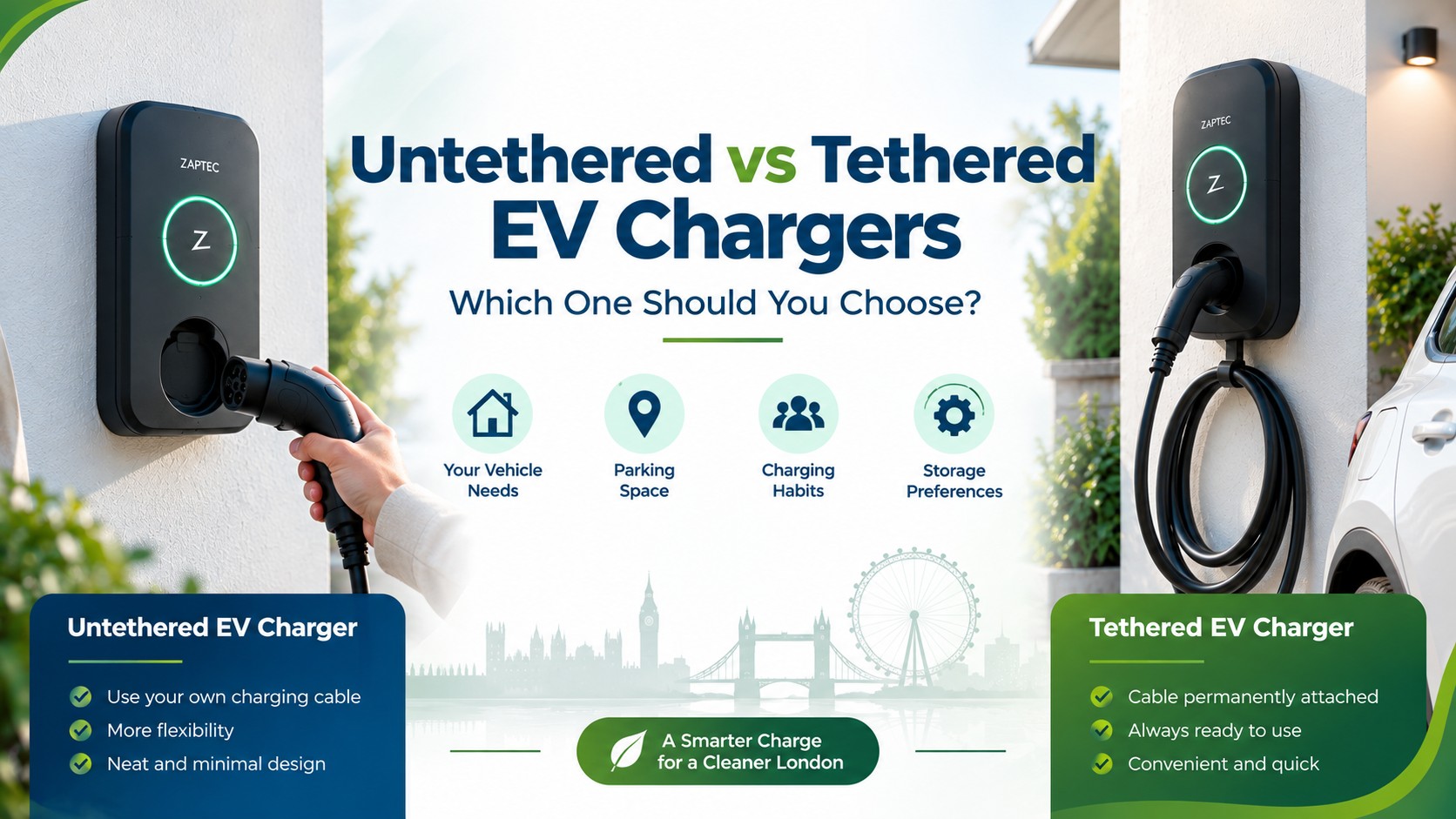
Home charging can make owning an electric vehicle much easier. Instead of relying on public charging, you can charge your car at home while you sleep or go about your day.
When choosing a home EV charger, one important decision is whether to choose a tethered or untethered model. The difference is simple: a tethered EV charger has a cable permanently attached, while an untethered EV charger has a socket and uses a separate charging cable.
Neither option is automatically better. The right choice depends on your vehicle, parking space, charging habits, storage preferences, and everyday routine.
What Is a Tethered EV Charger?
A tethered EV charger has a charging cable permanently connected to the charging unit. When you arrive home, the cable is ready to connect directly to your vehicle.
This can be particularly convenient for drivers who charge at home regularly and want a simple charging routine.
Why Choose a Tethered Charger?
A tethered charger may suit you if you:
- Charge at home frequently
- Have a dedicated parking space
- Want the cable ready whenever needed
- Do not want to store a separate charging lead
- Prefer maximum everyday convenience
The main consideration is cable management. You will need a suitable way to keep the attached cable neat and protected when it is not in use.
What Is an Untethered EV Charger?
An untethered EV charger has a socket instead of a permanently attached cable. You connect a separate compatible cable whenever you want to charge.
Once charging is complete, the cable can be disconnected and stored away. This can create a cleaner appearance and give you more flexibility over cable choice.
Why Choose an Untethered Charger?
An untethered charger may be suitable if you:
- Want a cleaner-looking installation
- Prefer to store the cable away
- Want flexibility over cable length
- Already keep a charging cable in your vehicle
- Regularly use public socketed chargers
The trade-off is that you need to retrieve and connect the cable each time you charge.
Both options can provide effective home EV charging. The main difference is how they fit into your daily routine and how you prefer to manage the charging cable.
Which Is More Convenient?
For many homeowners, a tethered charger is the simplest option. You arrive home, connect the attached cable and start charging.
With an untethered charger, you need to get the cable first. While this only takes a moment, it can become noticeable if you charge several times a week.
Choose tethered if your priority is everyday convenience. Choose untethered if you prefer flexibility and do not mind handling a separate cable.
Which Looks Better?
Appearance depends on your property and installation location.
A tethered charger keeps its cable attached even when you are not charging. Good cable management can keep the installation neat and reduce the chance of the cable becoming an obstruction.
An untethered charger can look more discreet because the cable can be removed and stored away. This may be useful when the charger is installed on a visible wall or in a compact parking area.
However, appearance should not be the only consideration. Think about where the cable needs to reach and how it will be stored.
Does Tethered Mean Faster Charging?
No. Whether a charger is tethered or untethered does not determine charging speed.
Charging speed depends on the charger's power capability, your home's electrical supply, the cable where applicable and your vehicle's maximum charging capacity.
When choosing an electric vehicle charger, consider the complete charging system rather than just the cable arrangement.
Consider Your Parking Space
Your parking arrangement should influence your decision. Consider:
- Where the charger will be installed
- Where your vehicle's charging port is located
- The distance between the charger and car
- Where the cable will go while charging
- Whether the cable could create an obstruction
This is particularly important for narrow driveways or areas used by pedestrians. Proper positioning and cable management can help prevent unnecessary damage or hazards.
What If You Change Your EV?
Think about your future vehicle as well as your current one. Charging-port positions can vary between vehicles.
An untethered system can offer flexibility because the cable is separate from the wall-mounted unit. However, a well-planned tethered charger can also be an excellent long-term solution if convenience is your priority.
If you expect to change vehicles, consider cable compatibility, and charging requirements before choosing your home EV charger.
Which EV Charger Is Right for You?
Choose a Tethered Charger If You:
- Want the simplest charging routine
- Charge at home frequently
- Park in the same place regularly
- Do not want to handle a separate cable
- Have a practical way to manage the cable
Choose an Untethered Charger If You:
- Prefer a cleaner installation
- Want to remove the cable after charging
- Value cable flexibility
- Already carry a charging cable
- Do not mind separate cable storage
There is no universal winner in the untethered vs tethered EV chargers comparison. The right choice depends on your vehicle, property, parking arrangements, and charging habits.
Do Not Forget EV Charger Installation
Choosing the charger is only part of the process. EV charger installation should also consider the unit's location, cable route, electrical supply, parking arrangement, and vehicle requirements.
A professional assessment can help identify a suitable charger position and determine whether additional electrical work is needed. It can also help you understand how the chosen equipment will work with your property.
At Infinity, we help homeowners explore suitable EV charging point solutions based on their property and requirements. We also offer a free, no-obligation survey to discuss your needs before proceeding.
Make Home EV Charging Simpler
Your EV charger should make your routine easier, not more complicated.
A tethered charger can be ideal if you want a quick and convenient connection every time you arrive home. An untethered charger may be better if you prefer a discreet installation, removable cable, and greater flexibility.
The best choice is the one that works for your vehicle, property, parking space, and charging routine. Consider convenience, cable management, appearance, flexibility, and future vehicle requirements before making your decision.
Get a Free Quote Today
Thinking about installing a home EV charger? Contact Infinity today to arrange your free, no-obligation survey and discuss the right EV charging solution for your home.
Ready to improve your home's energy efficiency?
Check your eligibility for grants and book a free survey with our team.
Book Free Survey